
What Is Agentic AI for Small Business in 2026?
- John Stephenson
- Feb 3
- 6 min read

If you've been following AI trends, you've probably noticed a shift. The conversation has moved beyond chatbots and content generation. In 2026, the real momentum is around agentic AI.
It sounds technical, but the idea is surprisingly practical for Canadian small businesses. This guide will show you what agentic AI does, where it fits in your operations, and whether you're ready to implement it.
Direct Answer: What Is Agentic AI?
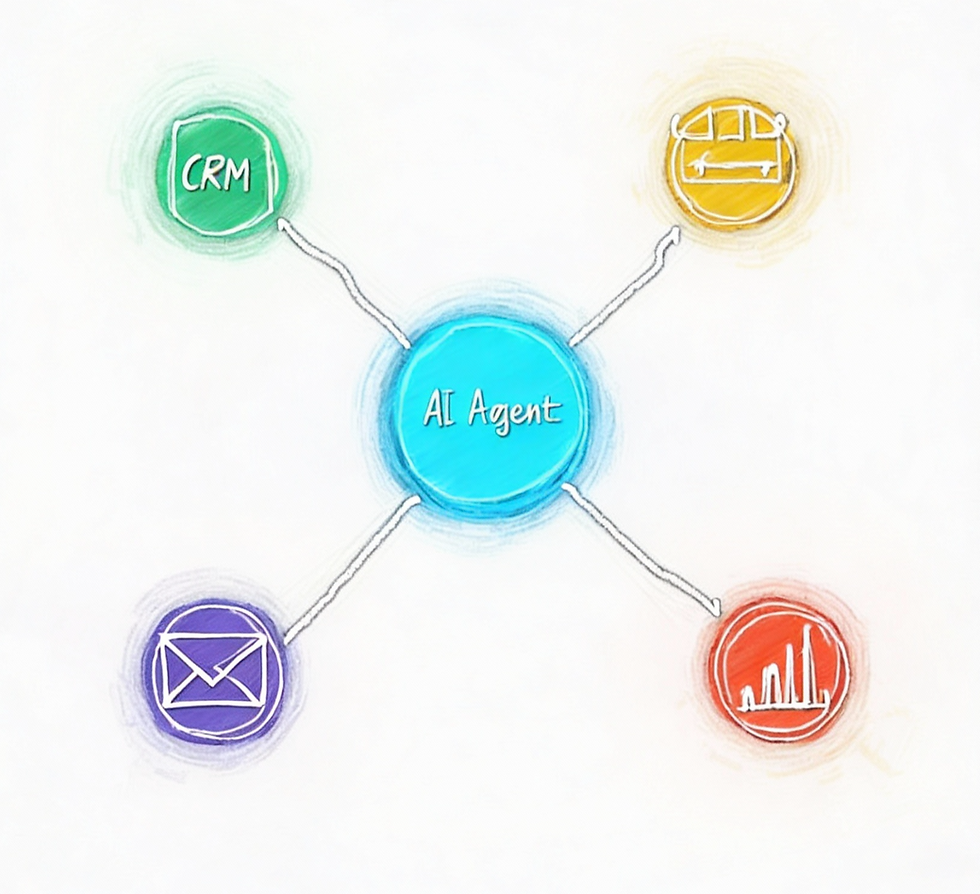
Agentic AI refers to AI systems that take action, not just respond to prompts. These systems follow predefined rules, make decisions within set boundaries, and complete multi-step tasks across your tools without constant human oversight. For small businesses, agentic AI acts like a digital operator handling repetitive, decision-based work so your team can focus on growth.
How Agentic AI Works
At its core, agentic AI combines three things: a clear goal you define, access to your tools and data, and the ability to decide what to do next.
Traditional AI waits for instructions. Agentic AI works from intent. You define the objective and constraints. The agent figures out the steps.
For example, instead of asking AI to draft a follow-up email, an agentic system monitors new leads, qualifies them, sends personalized responses, logs activity in your CRM, and alerts you only when human input is needed. You don't trigger each step manually.
This is why people describe agentic AI as "AI that runs workflows."
Why This Matters for Canadian Small Businesses
Canadian small businesses face unique challenges in 2026. Teams are lean. Customers expect fast responses across time zones and sometimes in both English and French.
Competition comes from both local businesses and larger U.S. companies.
Agentic AI helps bridge that gap. A three-person team in Calgary can deliver response times that used to require ten people. A solo consultant in Montreal can manage professional client onboarding without working weekends.
What changed recently is reliability. Agent frameworks are more stable. Tool integrations are stronger. AI systems now handle conditional logic and error handling in ways that were fragile even a year ago.
Common Use Cases
Agentic AI shows up most clearly in operations. Here are examples Canadian small businesses use:
Lead intake and follow-up: An agent monitors form submissions, enriches lead data, assigns qualification scores, sends tailored responses, and escalates high-intent leads to humans.
Customer support triage: An agent classifies requests, resolves simple issues using help documentation, routes complex cases with full context, and can handle bilingual routing for English and French customers.
Finance workflows: Agents reconcile invoices, flag anomalies, follow up on overdue payments, and update accounting systems based on thresholds you set.
Internal reporting: An agent collects weekly metrics, checks for trends, generates summaries, and delivers insights without manual spreadsheet work.
Notice these are rule-based, repetitive, decision-driven tasks. That's exactly where agentic AI works best.
Not sure which workflows could benefit from agentic AI? Book a free 15-minute workflow review and we'll identify your highest-impact opportunities.

What Agentic AI Is Not
Agentic AI does not replace judgment, strategy, or leadership. It doesn't magically understand your business without structure.
In fact, agentic AI fails when processes are unclear. If your workflows are inconsistent or undocumented, the agent has nothing stable to follow. Agentic AI amplifies process quality. It doesn't create it.
If your current process produces inconsistent results when humans follow it, an AI agent will simply execute that messy process faster.
Getting Started: What You Need
Before building any agent, answer these questions:
What triggers the process? Where does a human need to step in? What decisions follow consistent rules? What data and tools are required?
Most successful implementations start small. One agent. One workflow. One measurable outcome. Choose a workflow that happens at least weekly, follows consistent rules, takes 30+ minutes each time, and has clear success metrics.
Tools and Costs
Small businesses use platforms like n8n, Make, or Zapier paired with AI models. These let agents call APIs, update databases, and make decisions.
Typical costs for Canadian small businesses:
Platform costs: $50-200/month
AI API costs: $20-100/month
Setup time: 10-20 hours
Ongoing maintenance: 1-3 hours/month
Total first-month investment: $500-2,000 including setup. Ongoing monthly: $100-400.
Expected returns after 2-3 months:
8-15 hours/week saved on admin tasks [source needed]
40-60% faster response times [source needed]
25-35% reduction in data entry errors [source needed]
Important Safeguards
When systems act automatically, errors scale faster. Good agentic setups include:
Clear permissions: Only access explicitly granted tools and data.
Decision limits: Boundaries on spending and actions without human approval.
Logging: Record every action for review.
Human override points: Scenarios where the agent must pause.
For Canadian businesses, privacy matters due to PIPEDA. Ensure appropriate consent for automated processing, data handling meets Canadian standards, and you can explain to customers how their information is used.
Frequently Asked Questions
What is agentic AI and how is it different from regular AI?
Agentic AI takes actions across your business tools based on rules you define, rather than waiting for prompts. Regular AI waits for instructions. Agentic AI monitors systems, makes decisions within your boundaries, and completes workflows automatically. It's the difference between an assistant who waits and a team member who handles entire processes independently.
How do I know if my business is ready?
You're ready if you have at least one workflow that's repetitive, follows consistent rules, and takes significant time each week. You also need basic documentation of that process. If your processes change constantly or you can't articulate the steps clearly, focus on documentation first.
What does it cost for a Canadian small business?
Typical costs range from $100-400/month after setup. Setup costs vary: DIY takes 10-20 hours of your time, while professional implementation costs $1,500-5,000. Most businesses find that automating one high-value workflow pays for the investment within 2-3 months.
Is agentic AI secure for customer data in Canada?
Security depends on proper setup. Use platforms with appropriate data residency options, follow PIPEDA requirements, implement access controls, and maintain audit trails. For sensitive customer data, consult with someone familiar with Canadian privacy requirements before automating.
What are common mistakes to avoid?
The biggest mistake is automating unclear processes. If your workflow isn't consistent when humans do it, AI won't fix that. Other mistakes include automating everything at once instead of starting small, skipping testing, not setting up monitoring, and giving agents too much access without guardrails.
How do I get started?
Identify one repetitive workflow that happens weekly, follows consistent rules, takes 30+ minutes, and has clear metrics. Document it step-by-step. Then decide whether to build it yourself, buy a solution, or hire help. Most businesses benefit from a consultation to assess readiness first.
Glossary
Agentic AI: AI systems that take action across tools and make decisions within defined boundaries, completing multi-step workflows autonomously.
Agent: A configured AI system designed to handle a specific workflow, like lead follow-up or invoice reminders.
Orchestration platform: Software that connects different tools so they can share data and trigger actions. Examples: n8n, Make, Zapier.
Guardrails: Rules and limits controlling what an agentic AI system can and cannot do, like spending limits or approval requirements.
Conditional logic: Rules determining what action an agent takes based on specific conditions, like "If invoice overdue by 7+ days, escalate to manager."
The Real Opportunity
The biggest advantage Canadian small businesses have is flexibility. You can redesign workflows quickly and implement changes the same week.
Agentic AI lets you operate with the efficiency of larger teams without adding headcount. When implemented properly, it reduces cognitive load. Fewer decisions. Fewer follow-ups. Less context switching.
The real value isn't in futuristic promises. It's in quieter workdays. Leaving the office at 5 PM instead of 7 PM. Weekends without administrative tasks. Mental space to think strategically.
Next Steps
Agentic AI is not a trend to chase blindly. It's a capability you earn through structured processes. Canadian small businesses that succeed understand their processes deeply enough to automate them safely.
In 2026, the question isn't whether AI can help. It's whether your business is ready for AI that takes action.
If you're curious whether agentic AI makes sense for your business, the best next step is assessment. Look at your workflows. Identify what's repetitive and rule-based. Document one process completely.
Ready to explore how agentic AI could work in your business? Book a free 15-minute consultation. We'll review one workflow and give you a clear recommendation on next steps. No obligation.


Comments